Environmental
Our Climate Actions and Performance
As a pharmaceuticals manufacturer, Duopharma Biotech seeks to minimise as far as possible any negative footprint we have while putting in place systems and processes to create positive outcomes. Our Climate Performance-related initiatives cover carbon emissions and energy usage reduction, improving water management efficiency as well as reduction in waste generation.

Carbon Emissions Management
Human activities have released greenhouse gases (GHG), driving global warming and consequential climate change impacts such as severe droughts, rising sea levels, increased flooding, and more frequent intense storms. At Duopharma Biotech, we’re committed to mitigating these effects by continuously improving our GHG monitoring and reporting mechanisms, with a focus on carbon emissions, as we move toward a carbon-neutral path. Our goal is to annually reduce 10% of our Scope 2 carbon emissions and ultimately achieve Carbon Neutrality by 2030 and Net Zero Carbon Emissions by 2050. In 2022, we began our Scope 3 accounting journey by prioritizing significant Scope 3 emission sources and established a GHG Scope 3 Roadmap – six categories of GHG Scope 3 were identified as relevant to report.
Our Climate Roadmap details a spectrum of strategies covering short, medium, and long-term approaches to reduce carbon emissions and improve energy efficiency. Simultaneously, we have established a Net Zero Transition Plan (“NZTP”) which serves as a strategic framework outlining key enablers and initiatives to guide Duopharma Biotech’s transition towards becoming a Net Zero carbon emissions organisation by 2050. The NZTP is further supported by a 5-Year Energy Efficiency Plan, which focuses on driving energy performance improvements as one of the key enablers of this transition, in line with the global objective of limiting the rise in global temperatures to a maximum of 1.5°C above pre-industrial levels. The implementation of these initiatives will also facilitate the attainment of Carbon Neutral by 2030 target.
Our carbon and energy reduction initiatives:
- Energy Audit
- Duopharma Biotech has conducted Level 1 Energy Audit from January to April 2022. The audit was performed at all Duopharma Biotech’s major production facilities to understand our current energy consumption usage, and to identify potential energy saving opportunities for implementation.
- We are also intend to perform a comprehensive energy audit in 2024 that will involve a more detailed energy consumption, usage patterns and efficiency measures.
- Implementation of Energy Efficiency Initiatives
- Installation of dual condensing units for air-conditioning system to improve heat rejection capability and increases unit’s efficiency, based on the recommendation from our energy audit.
- Replacement of all old fluorescent tubes to light emitting diodes (LED) to ensure we use energy optimally.
- Installation of split air-conditioner system for an efficient and cost effective usage. We also shut down the Air Handling Unit (AHU) and Dehumidifier during the night when they are not in use.
- Installation of Solar Photovoltaic Rooftop System in all three manufacturing sites: Klang, Bangi and Glenmarie will commence in Q4 2023. This is to reduce our dependence on purchased electricity.
- Electric Vehicle (EV) Charger Installation
- We lay the foundation for a smarter, reliable and emission-free mobility by installing EV Charger for our staff. The installation aims to promote green mobility and support reduction of our GHG Scope 3 emissions.

Efficient Water Management
Water is a pressing need in many areas of the world. Water scarcity may impose high risk to operations as water is essential for growing and processing food, generating energy, and supporting industries for a continually growing population. At Duopharma Biotech, we believe the importance of comprehensive water management through consistent monitoring of water consumption, implementation of water efficiency initiatives, and responsible management of effluents and wastewater to protect local water resources.
Duopharma Biotech Berhad’s operations are primarily based in Malaysia, with three main manufacturing facilities located in Klang, Bangi and Glenmarie (State of Selangor), supported by distribution depots in the state of Kelantan, Penang, and Johor – with one depot office in each state. We have regional presence in the Philippines, Indonesia and Singapore, which includes one sales and marketing office in each country. Our Malaysian manufacturing sites rely on municipal water supply for production and utilities. While the Selangor region occasionally experiences supply interruptions due to rising industrial and population demand, these locations are not classified as high-water-stress areas.
Beyond Malaysia, we have identified that our regional offices in Manila and Jakarta are located in medium-high and high-water-stress region, respectively. However, given the nature of office operations, water consumption from these locations is very-minimal, collectively accounting for only 0.03% of total Group annual water usage. Therefore, the overall water-related risk from these regions remains low.
Recognizing the varying water conditions across our operational footprint, Duopharma Biotech Berhad established a comprehensive Water Management Plan that covers all manufacturing facilities, depots and relevant operational sites. The plan provides clear guidelines and procedures for monitoring water consumption and recycling, managing effluents and wastewater. For wastewater, the effluents characteristics are closely monitored by the Safety, Health and Environment (SHE) team every week, and reported to the Department of Environment (DOE) every month. The outcome of the monitoring (water usage and quality) are presented to the Group Management Committee on monthly basis.
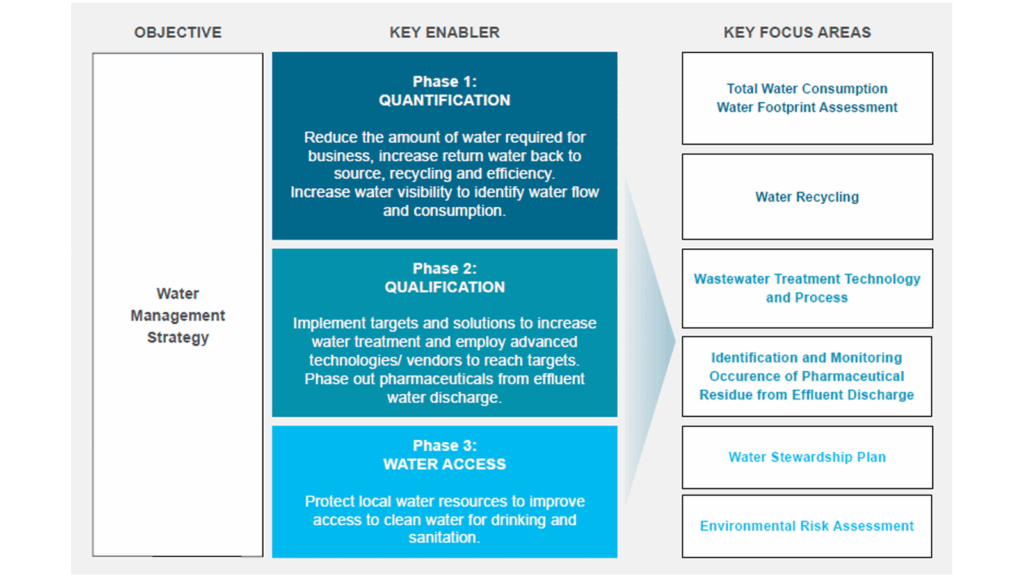
Building upon the Water Management Plan, Duopharma Biotech Berhad has established key targets to reduce water consumption and improving water quality, across three main focus areas:
- To reduce the amount of water required for business, increase return water back to source, recycling and efficiency.
- To increase water visibility to identify water flow and consumption.
- To implement targets and solution to increase water treatment and employ advanced technologies/vendors to reach targets.
- To phase out pharmaceuticals from effluent water discharge.
- To protect local water resources to improve access to clean water for drinking and sanitation.
Our water-related initiatives:
- Water Audit and Water Efficiency Initiatives
- Duopharma Biotech has conducted Preliminary Water Audit from August to September 2021. Following to the audit, we have implemented improvement initiatives to save unnecessary water loss by fixing water tap/pipe leakages, reducing toilet flush tank water level by 10%, and increasing the Cycle of Concentration (COC) of cooling tower.
- In-house Water Recycling
- At Duopharma Biotech we re-use treated waste water from purified water system for housekeeping and gardening purposes. We also use recycled water to reduce temperature of certain machines, such as autoclave.
- Rainwater Harvesting
- We have installed rainwater harvesting system, which includes two tanks that are able to store around 5,000 litres of rainwater each. The installation will help to reduce our dependency on natural water resources.
- Green Cleaning – Using Bio-enzyme as cleaning agent
- We reduce the usage of chemical cleaning agent for Heating, Ventilation, and Air Conditioning (HVAC), by replacing with bio-enzyme as an agent to wash the ducting and cooling element in HVAC. The bio-enzymatic cleaning are environmental friendly as it does not pollute the lakes and underground water.

Waste and Material Management
When waste is disposed of or recycled in a safe, ethical, and responsible manner, it helps reduce the negative impacts to the environment. Ensuring that waste and material management procedures are carried out responsibly and with regularity helps to avoid unnecessary waste generation. At Duopharma Biotech, we strive to ensure efficient use of materials, adopt best practices in waste disposal, strengthening our recycling efforts and ensuring compliance to relevant environmental laws and regulations throughout our operations.
Our waste management initiatives:
- Scheduled Waste
- Duopharma Biotech produces six types of scheduled waste, which are collected by licensed operators and disposed of according to regulations with proper disposal methods. We are environmentally responsible with our operations that we monitor and ensure proper management of scheduled waste, as guided by our Standard Operating Procedure. Training is provided by competent personnel to all departments involved in scheduled waste management.
- Recycling of Non-Scheduled Waste
- Non-scheduled waste is domestic waste that is non-hazardous such as papers, plastics and aluminium. In Duopharma Biotech, we fully monitor the volume of domestic waste generated and recycled at our sites. We have set a target to recycle 10% of non-scheduled waste generated annually.
- Waste Thermal Reduction System (Asher) Purchase
- Asher is an equipment used to burn our non-scheduled/ domestic wastes into ash to reduce the quantity of our waste sent to landfill. This initiative will facilitate the reduction of our company’s carbon emissions (Scope 3).
Management of Climate-related Risks
We recognize the increasing urgency of managing climate-related risks throughout our activities and operations, and we are actively addressing this concern. ‘Climate Risk’ has been identified as one of our top 10 material sustainability matters, reflecting its significance in our strategy.
Current efforts primarily focus on mitigation actions, including energy efficiency initiatives, the installation of solar panels, and the utilization of waste reduction thermal systems to reduce scheduled waste disposal to landfills. These measures are essential to reduce our environmental footprint. In parallel, we have initiated the identification of climate adaptation actions to enhance climate resilience. For instance, we are ensuring that all new facilities are constructed above sea level, fortifying our infrastructure against sea-level rise. Detailed adaptation strategies will be elaborated upon in the near future.
Moreover, our comprehensive climate risk management measures encompass the assessment of climate-related risks and impacts for all new projects before approval and commencement, their subsequent inclusion in Enterprise Risk Management (ERM) for continuous monitoring and mitigation, and oversight by our Board of Directors, who incorporate ESG and climate-related risks into their decision-making processes as a vital assessment requirement.